
Break into Product Management: A Comprehensive Transition Guide
Breaking down how to navigate a career transition into Product Management

Product Management is arguably one of the most coveted career paths right now. McKinsey Digital said it pretty well: “Marc Andreessen’s observation from more than ten years ago that ‘software is eating the world’ needs an update: software is the world. The software industry continues to grow at a massive clip. More and more traditional companies are realizing that to compete and grow in a digital world, they must look, think, and act like software companies themselves.”
Every company is becoming a software company. And if that reality continues to take hold, then the Product Management (or its equivalent) function is going to be the center of gravity for every company.
So it’s no wonder that so many professionals, early career and experienced, want to break into Product Management. Being a Product Manager (PM) puts you at the intersection of strategy, technology, design, and innovation. You get to build and define the way work gets done and the way technology integrates into our everyday life. So how does one break into Product Management? What if you don’t have a Computer Science background? Do you need X years of experience to even get a chance? How do you get that first break?
Let’s dive in.
The journey at a glance
Admittedly, a single path into Product Management is very hard to define. Ask ten product leaders how they first got into it and the majority will likely tell you it was serendipitous. But, there is a tried and true path that works. I’ve coached PMs through this path and have seen it work every time. So it is a path that should be followed for the greatest chance of success. But of course it goes without saying, your mileage may vary. Here’s the breakdown:
Get a “feeder role”
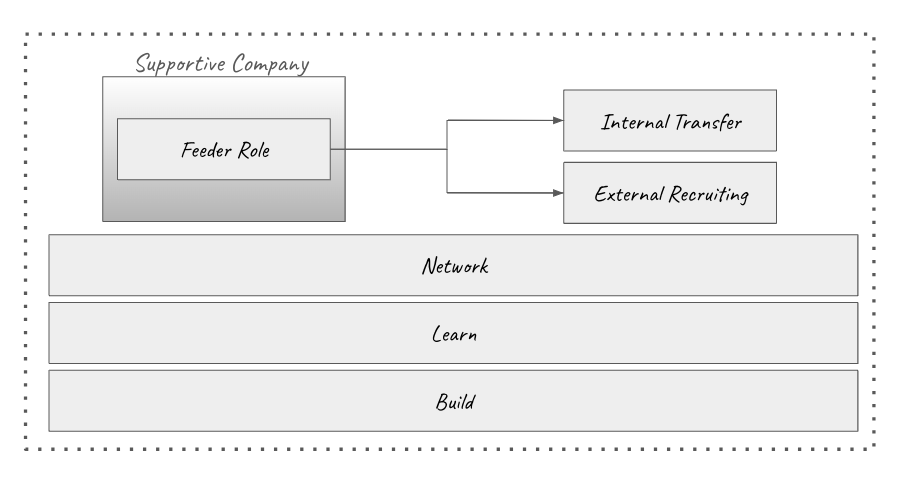
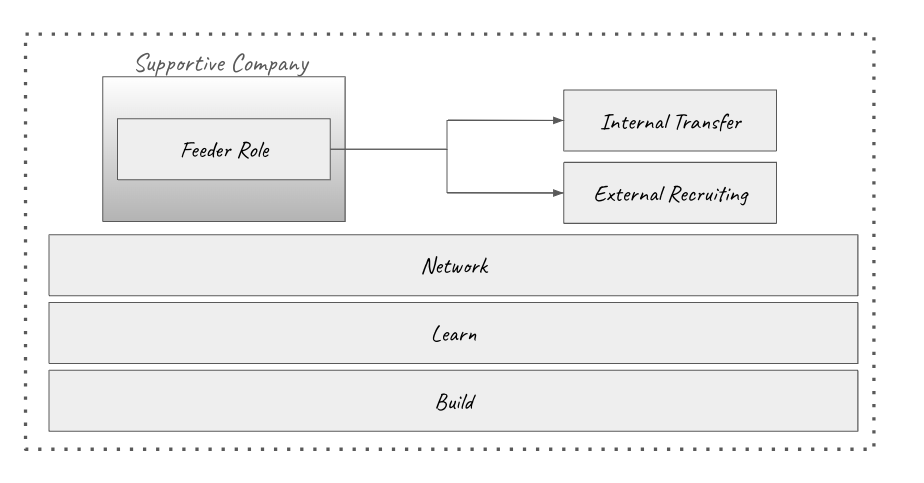
Join a product-led company that supports (and ideally has a structured process to support) internal mobility
Pursue the internal transfer path and recruit externally
Simultaneously: network, learn, and build
Consider the alternate paths: an advanced degree (e.g., an MBA) or an APM/RPM program
1. Get a feeder role
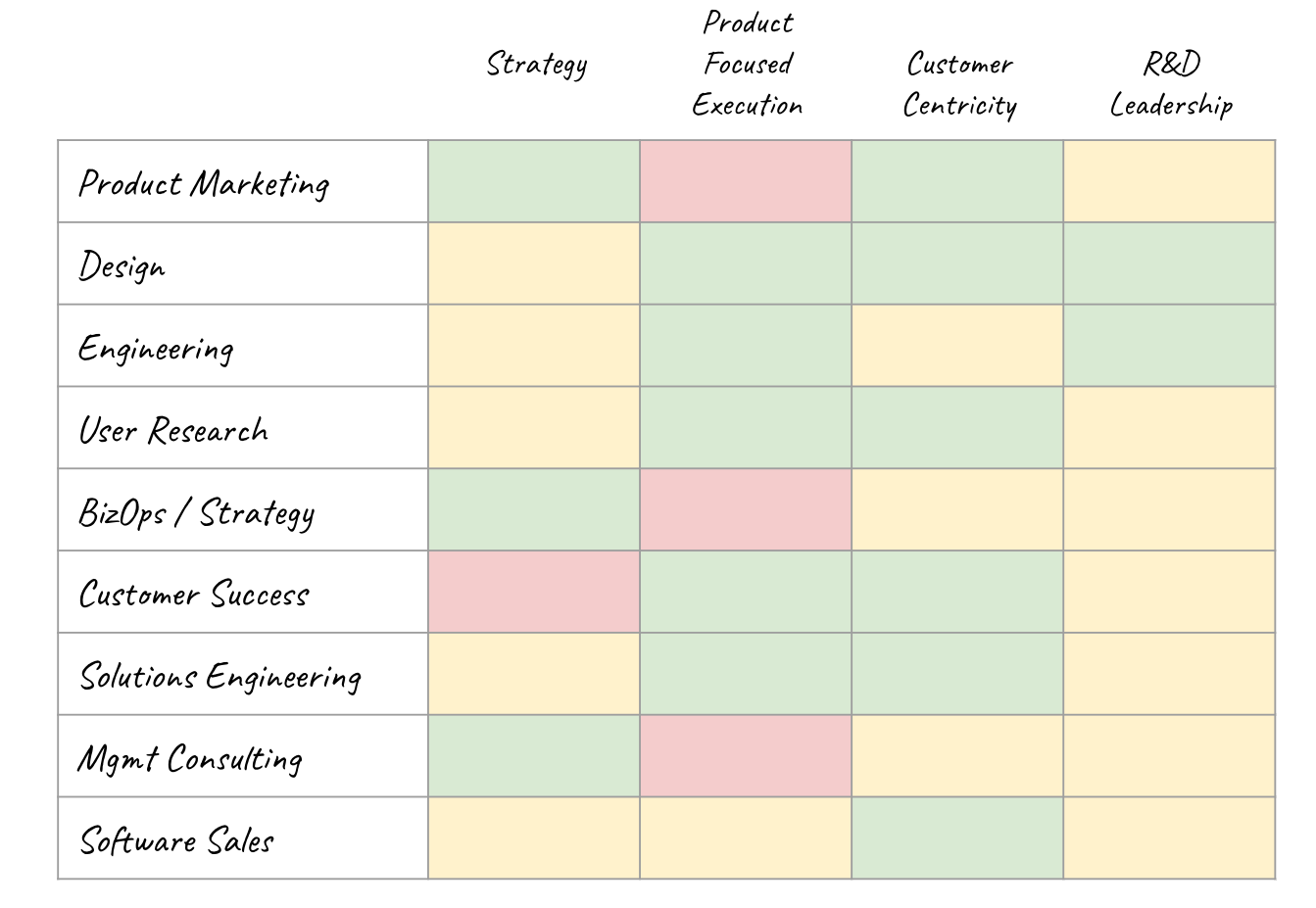
The prerequisite to breaking into Product Management is that you have some familiarity on how software is built, marketed, and sold. This usually comes from working in a role adjacent to Product Management at a company that builds, markets and sells software. As an extreme antithetical example, your chances of breaking straight into Product Management if you are a Financial Analyst at the corporate office of a major restaurant chain is likely slim to none. Your baseline is being in one of the feeder roles listed below (disclaimer: this is not an exhaustive list, but it does cover the major ones).
The color coding here represents the likelihood that the role listed does that type of work or gains that skill in their day-to-day. These skills are critical to being a successful PM and serve as the foundational ingredients to be able to deliver what is expected of you as a PM (Another disclaimer: this table is probably generalizing a bit, but I believe, from experience with multiple non-PM to PM transitions, that it is directionally accurate).
Let’s define each dimension for clarity:
Strategy — deeply understanding market trends, business models, the competitive landscape and the ability to synthesize and contextualize these things to generate positive business outcomes for the product your company sells
Product Focused Execution — building software. the day-to-day of deciding on, prioritizing, and being able to spec out what to build, when to build it, and why. This doesn’t necessarily mean writing the code (that’s definitely a bonus!), but it does mean understanding how new investments and incremental features solves user problems and improves your product
Customer Centricity — working closely with and deeply understanding customers and their needs
R&D Leadership — the unique experience of managing R&D outcomes (e.g., balancing new feature development and existing feature enhancement, working through technical complexity, aligning multiple product development teams working towards the same goal, finding the next problem to solve within an R&D group). In most cases, this experience is usually only gained when you work in R&D (i.e., in the table below that is the Engineering, UXR, and Design disciplines)
With all of the above in mind, to give you the best chance at breaking into PM, you first want to look to move into a feeder role that has the most green across the board. Don’t be afraid of the red, it’s just something to know for the next stage — the jump from feeder role to PM role.
2. Join a product-led company that supports internal mobility
Being in a feeder role is a great starting point, but the environment you’re in dictates if that feeder role ever actually feeds into anything. This is why its important, in addition to being in a feeder role, to be at a company that encourages internal mobility and where there is a track record of non-PMs moving into the PM role. From my own experience most mid to large tech companies (e.g., Asana, Meta, Google, Microsoft, Salesforce, etc.) have processes and precedent in place to do this. Smaller companies may have more fluidity and allow this, but its a toss-up. The company needs to have enough existing PM talent (and runway…) to be able to absorb the time it takes for a brand new PM to ramp up and be impactful.
Another route to take is joining a very early stage (Seed to Series A) company in a feeder role and try to wear the hat of PM in addition to your core responsibility. This stage of company is volatile, and things change so much that you may be able to squeeze your way in as a PM. This is much less defined and you run the risk of it never happening. It is, however, a path you can take if it is made available to you.
All in all, you need to ensure that your existing role (i.e., a feeder role) is PM adjacent and that you are at a company where internal transfers have happened and they have been successful. This is the foundation you need to have a clean shot at breaking into Product Management. Is this absolutely required? Of course not. But, this guide is intended to give you a roadmap that has been successful multiple times. Adjust as you see fit.
3. Pursue the internal transfer path and recruit externally
Assuming you are squarely in a feeder role and are at a leading tech company that has a history of successful internal transfer to PM situations, you’ve set your foundations well. Now it’s time to focus on getting the PM role. A few things to note before getting into this:
Go broad. Do not focus on a specific type of PM role. In other words, don’t be fixated on becoming an “AI PM.” You will not only extend your timeline to successfully land a PM role, but you’ll have significantly less at bats. Open yourself up to the possibility of every PM role. Even the “boring” ones
Be realistic about timeline. This is not an overnight process, but the time investment is worth it. Expect, from this point, at minimum 12 months and more likely 24+ months to successfully break in and make the transition. Careers are multiple decades so focus on playing the long game. It might feel frustrating and you might feel like you’re not making progress. That’s not true. Follow your plan and keep putting in the effort — it will take time
Don’t lie. I’ve seen it many times and its just not worth it. Don’t state that you’re a Product Manager at X company when recruiting for external roles. You can certainly highlight parts of your job that line up with the PM job, but I highly advise against outright lying. You may not get caught, but your integrity is not worth any job
Now that those ground rules are in place, let’s jump in to the internal transfer and external recruiting paths.
Internal Transfers
As an internal transfer, you have two points of leverage over experienced PMs that the company could hire from outside 1/ company and product context and 2/ access to internal teams. Pushing on these points of leverage is the most important thing you can do.
Company and product context: You know the product and company culture which gives you the power of information asymmetry. You know what products and teams are growing, what investments are of most strategic importance, and where teams are crunched for capacity. Candidates on the outside do not know these things. Take advantage of this by gravitating towards working with the teams where they need extra hands. Get to know how they build product and make decisions. Volunteer your time to help PMs with day-to-day tasks in an effort to learn from them. Even better if your day job can be changed to work with these teams as a core team member. As an example, maybe you are a Product Marketing Manager that supports Microsoft Teams. You might know that Copilot is up and coming and those teams are frantically trying to ship new features and explore new use cases. Get close to folks on that team and try to work on a project with them. Even unofficially. This might take a bit of navigating, but its worth it in the long run. While you are doing this, you need to fully understand the internal transfer process. What does it take to get a role? Do you need a certain level of executive or leader to sponsor the transfer (for example, this is common at Meta) or do you need to be at the company for X number of years? Get in touch with your HR team or dig through internal policy documents and figure out exactly what you need to do to be eligible for an internal transfer if/when the right opportunity comes up for you. Loop in your manager if it makes sense to do so. They can be a good resource for you, but this could also be a bit awkward. Each situation is different, so evaluate yours, seek advice, and make a decision. Note that I coupled the formal internal transfer process and working closely with growing teams together because doing one without the other usually doesn’t work out. You could make sure you’re eligible for an internal transfer and wait for a role to open up, but that’s the same as cold applying to roles. You might get a shot at an initial conversation, but its so much more leveraged when you already know the hiring team and they’ve worked with you before. Expand your surface area for luck and usually opportunity will follow.
Access to internal teams: I cannot stress enough how advantageous it is to have direct access to people inside a large company. Whether its the ability to Slack message them or email them directly with the same domain name, you are in a very strong position when compared to candidates on the outside. Use this to your advantage. Aim to set up at least one intro conversation a week. This isn’t meant to be empty “go network internally” advice, but more of a nudge to use the fact that you’re inside the walls of a company to your advantage. Message a few PMs (both leaders and ICs) every week and be clear about your intention and what you’d like from them. Tell them you’re really interested in breaking into PM and at this stage you’re purely looking to learn and get any bits of advice they have. Offer to buy them coffee for 15 minutes of their time. Keep doing this and scheduling conversations. You will get ignored many times, but keep going and stay persistent. Genuinely lean into these conversations as a way to learn and grow your understanding of the Product Management discipline, what it takes to break in, how PMs are evaluated at the company, etc. Do not go into these conversations with the mindset that you’ll come out with concrete next steps (or worse, with some sort of a job) because you won’t. This is purely an exercise to broaden your understanding of Product Management inside whatever company you are at and to grow your PM network. Again, expand your surface area for luck and usually opportunity will follow.
External Recruiting
Your path to break into Product Management is strongest when you try to do it internally, but you should definitely spend the energy to recruit externally as well. The most impactful way I’ve seen external recruiting pay off is if you are in a feeder role and working on something very specific and industry/subject matter expertise is much more valued than functional Product Management expertise on a specific role that a company is hiring for. As an example, I coached a mid-career Strategy/BizOps professional on the transition to Product Management. We used their expertise in the logistics and transportation industry to secure an external PM role for a company in the same industry looking to build out a product very much centered around the knowledge that they had. All the same rules of external recruiting apply. Get referrals, warm introductions, and play the long game. When making a pivot into Product Management, its important that you tell the story that highlights the unique experience you have for a PM role. Did you work closely with the Design and Engineering teams on a major product launch? Did you help write the requirements and oversee the build out of an internal tool that is now widely used? Did you do a bunch of UXR? Before going out to externally recruit, identify the best version of your story that gives clear signal of your readiness to take on an early PM role. Make sure that is reflected on your resume, but more importantly, make sure that you are telling this story as you have conversations with recruiters and other PM professionals in the industry.
4. Network, learn, and build
The above steps are generally sequential. You mostly do one before the other. When it comes to networking, learning, and building, these activities should be ongoing. These are core areas that you need to keep working on while on your journey to break into Product Management. This is a marathon, not a sprint, so focus on setting up cadences that are sustainable and benefit you in the long run:
Networking: My guidance here is to focus less on specific outcomes (e.g., interviews secured) and instead on conversations per month. Aim to have at least 2 substantive conversations per month with no expectation of an outcome. The best way is for this is to get warm introductions, but that’s not always possible. If you can’t secure conversations through warm intros, go broad on your top of funnel efforts and lean in to cold messaging to start. You can reach out to 50 people a month on LinkedIn with a very catered message that you’re looking to learn from people in the industry and would love to ask for 15 minutes of their time. The idea is here is to expand your network and inflow of potential opportunities in the medium to long term. Not in a matter of weeks. The more people you talk to and involve in your journey of breaking into Product Management, the more you are expanding the potential of getting an interview opportunity. Some notes:
Do not have a generic message that you blast out to hundreds of people. It won’t work. Be targeted and specific with your reach out (even if it’s a cold message)
Do not ask for anything up front. Be humble, helpful, and honest. You are looking for advice because you have a specific goal you’d like to achieve. Say that
Do ask how you can help the person you are having a conversation with. Networking works when you are genuinely trying to be helpful and not expecting something in return. This will pay dividends in the long run
When you do have conversations, do ask who else the person on the other side thinks you should talk to and ask for the intro if it makes sense to
Learning: You need to learn Product Management, but also how to interview for Product Management roles (unfortunately, the two aren’t always the same set of lessons). I advise against specific certifications or degree programs that claim to better prepare you to get a PM job. These are not useful and usually too generic to be beneficial. Instead, dig into something like Exponent to take courses, practice interviewing, and potentially get some live coaching. The idea here is to get structured learning to help educate you and help you speak the PM language, but also so that you are always ready for interviews
Building: Go build something. This is by far the most leveraged “ongoing” thing that I’ve seen non-PMs do to enable their transition into Product Management. When I say build, I mean to go help build a product with a group of friends (there are a ton of no code solutions out there to get started!). Build a community, write a newsletter that does deep dives into tech companies and their products or find a super early stage startup that could use some additional (free) capacity and volunteer your time. Find something to do that let’s you build and get real live reps of what it takes to be a PM. The more people you can meet and the more you can bolster your resume to be directionally aligned with the Product Management function, the better your odds are to successfully transition
5. The alternate paths: advanced degreed and APM/RPM programs
Advanced Degrees
This area is highly controversial, but I have a strong opinion about it. I would not recommend pursuing an advanced degree to break into Product Management. While there are certainly exception scenarios (going to a top MBA program and on-campus recruiting into a PM role at companies that offer this — like Amazon) this path is usually a giant waste of time and money. Now, if you are genuinely interested in studying something and that naturally translates to a PM role afterwards (a PhD program in ML landing you in a PM role on an ML product) then please go right ahead, but do not make “getting the PM role” the impetus for your decision.
APM/RPM Programs
APM, RPM and PM development programs are a fantastic way to break into PM and are uniquely designed for early career professionals without a background in tech (i.e., you don’t need to be in a feeder role). I had the pleasure of being deeply involved in Facebook’s RPM program and managing RPMs myself so this is an area near and dear to my heart. There are a few things to note here:
They are HIGHLY competitive. You are competing against some of the most accomplished new grads, early career professionals, and even folks pivoting from doing some impressive things (an RPM I knew at Facebook had pivoted from a PhD in Aerospace Engineering and was on the team that won a Nobel Prize. She was quite literally a rocket scientist…)
Referrals are usually not allowed. Networking doesn’t do much for you here. The administrators of these programs are trying to prevent any unfair advantage so they evaluate candidates purely off their merit and experience (via their resume 🤔)
Not all APM/RPM programs are created equal. Some are much more advanced and well known (Google, Facebook, LinkedIn) and some are brand spanking new (for example, Ema, an Enteprise AI startup founded by the former Coinbase CPO just kicked off their APM program). The depth of programming and support will vary widely based on how long the program has been around. Additionally, the “post APM/RPM” situation (i.e., will you get promoted to a fully fledged PM automatically after finishing the program?) is unique to each company. Know the nuances and details before pursuing
They are specifically designed for early stage professionals. You can expect your peer group to skew to the younger side and your compensation to be on the lower side (relative to the standard tech salary, that is). This is totally fine, just something to consider
In closing
Breaking into Product Management is not an overnight game. It takes time, but in the long run is it absolutely worth it. There’s a reason why so many folks in tech (and outside) are looking to break in and become PMs. Product Management is a highly compensated and well-regarded function. As a PM, you can have significant impact across an entire company. Your career trajectory as a PM is also very strong as you become a very in-demand professional in a world where software is at the center of every company.
In closing, be patient, play the long game, and be measured in how you approach this transition. It can happen and has happened for thousands of people out there.
More from Reflections of a PM:


